Saturday, May 8, 2010

Salvador, Brazil


The last port we visited was Salvador, Brazil. It was weird knowing that it would be our last time getting off the ship in a new place before Fort Lauderdale. We had all become so used to the pre-port meetings, the diplomatic briefings, and the entire process of going through immigration and customs before disembarking the ship. And yet, no matter how many times we went through this tedious process, we never became jaded to the feeling of stepping off the ship and into an entirely new country and in some cases, like Brazil, an entirely new continent.

Brazil was no different. We arrived at the port on April 21st to a country that we had studied about in our classes, but were anxious to see for ourselves. Our first encounter was with some drummers and dancers who were there to welcome us. This only confirmed what we already knew about Brazil’s passion for music and dance. We made our way out of the port and out onto the sidewalk where we walked for a few minutes until we reached a huge marketplace. We had to walk though a marketplace, cross a busy street, and take a paid elevator ride in order to get to the rest of the city. (We were told that it was possible to take a cab there and it was safer to do so at night, but during the day this was the cheapest and easiest way to go.)


I got off the elevator and looked out over the waterfront and marketplace. The view of the different boats and ships docked at the edge of the city was one that would never get old. I was trying my best to take in all the little things that were part of our trip—things that I wouldn’t be able to experience in a few weeks. I walked out of the elevator and into the upper area of the city. There were old, beautifully designed buildings that looked almost European. We walked down the small cobblestone streets where people were eating lunch outside of cafes and coming in and out of boutiques. We could see women in banana skirts and brightly colored clothing. We could smell the food that was being cooked in the restaurants. But the thing that took over our senses the most was the sound of the music that was being played almost everywhere we turned. Whether it was coming from the radio of a small cafĂ© or the instrument of a street performer, the sounds seeped through every wall and every window, and vibrated throughout the entire city.


The people were beautiful and friendly as usual. They walked with pride and confidence. You could tell the women were comfortable with their bodies. We noticed this when we went to the beach later that day and saw women of all shapes and sizes in tiny Brazilian bikinis that hardly hid any part of their bodies. The men were no different, wearing nothing but tiny Speedos, regardless of their age or body type. (It was probably the best I’d ever felt in a bathing suit.) Even though it was raining a little bit, we could still take in the beautiful scene of the ocean and the people. The rain actually made it nice because the beach wasn’t too crowded—a complete contrast from the Ghanaian beach we were at the week before.


However, what made this beach similar to the one in Ghana was the restaurant set up. In both Ghana and Brazil, we sat at on casual outdoor tables with plastic chairs and an umbrella over our head. In both places we had waiters who would bring us menus and run back and forth to the kitchen to bring us our food. In Ghana, we were sitting fairly close to where the food was being made, but in Brazil we couldn’t even see where the food was coming from, especially with all the umbrellas everywhere. Our waiter didn’t seem to speak very good English, so we were always surprised when he came back with everything we had ordered.

The only time we things got lost in translation was when I tried to order ice cream. I pointed to word “ice cream” on the menu, but he didn’t seem to recognize it, even though it was written in English on the menu. In an attempt to help him understand, my friends and I kept saying “chocolate” and “vanilla.” He gestured to us that he understood and then quickly left the table. A few seconds later, we looked away from the beach and up onto the main road, where we saw him running (literally sprinting) down the street. I didn’t want to believe that he was running to get our food, but sure enough, a few minutes later, he came back with about 5 different types of chocolate bars. At this point I didn’t even care about the ice cream, I just couldn’t believe he had run all the way to the store and back to get us our food. I wondered if he had done this at any other point in the meal. Never has any waiter in the United States ever run down the street to get me something in the middle of my meal. Needless to say, we gave him a big tip.


That night we went out dancing. Since it would be my only night in Salvador (my Amazon trip was the next day) I knew that I had to experience the dancing of Brazil. It lived up to all my expectations. Women moved their hips in ways I didn’t even think were possible. And both men and women danced until they were dripping with sweat. It was quite a workout and us Americans could hardly keep up. Everyone was laughing and the music just took over our bodies. If I ever have the chance to visit Brazil again, I want to spend more time dancing. I’d love to try all the different styles and learn more of the moves. The music and dance in Brazil is truly captivating.

Unfortunately, on a negative note, a lot of people were mugged in Brazil, especially on our first night in Salvador. Thankfully, I was never mugged, but a large number of my shipmates were. It didn’t just happen at night or to people who were walking alone. It happened to several people during the day when they were walking in groups. People had necklaces ripped off them and cameras taken right out of the hands. Unlike the other countries where people were pick pocketed without even noticing, many of the muggers were aggressive and occasionally hurt the person they were mugging. It is so unfortunate that this had to happen because it made so many of us afraid.

I have to say, it was one of the only times I ever felt afraid on the trip. Each of the other times had been because I was in a bad area, it was late at night, or I was wearing or carrying something that made me stand out as a tourist. This was different because it seemed like there was nothing you could do to protect yourself. After that first day, I heard that people stopped taking anything with them. They tucked money in their underwear or bras and didn’t even bring their cameras. This could have been partly because they had nothing left to bring because it was stolen, but most likely it was because it wasn’t even worth the risk. I imagine it must have been a bummer not to be able to take pictures.

Despite the immense amount of muggings, I did not let this taint my impression of Salvador or of Brazil as a whole. It is a beautiful and vivacious place where attractive people and talented musicians illuminate the streets with an atmosphere of creativity and excitement. We learned that the level of happiness was the highest of all the countries we visited and even to a tourist who was only there for a short time, this joy was apparent.

Friday, May 7, 2010

Waterfalls & Mona Monkey Village Visit


After our hike on Afadjato Mountain, we walked (thankfully on flat land) about an hour to the Wli Waterfalls. They were definitely the highest waterfalls I’d ever been to and they looked especially beautiful because there was a huge rainbow going through them. We got to swim for a little while, which felt great after how hot we had been on our hike. Everyone really enjoyed themselves at the waterfalls. I only wish we had more time to stay. Unfortunately, we had an hour walk back to the village and a few hour bus ride to the hotel.

The hotel we stayed that night was really nice. (How SAS manages to find these diamonds in the rough, I have no idea.) The next morning, we visited another village that is well known for its Mona monkeys. These monkeys are considered sacred to the village and there is a huge effort to keep them and their habitats safe from harm. We didn’t just get to see the monkeys though, we got to feed them bananas right out of our hands! The best part is that we didn’t even have to peel them, the monkeys did it themselves! It always amazes me how monkeys can have such human-like mannerisms.

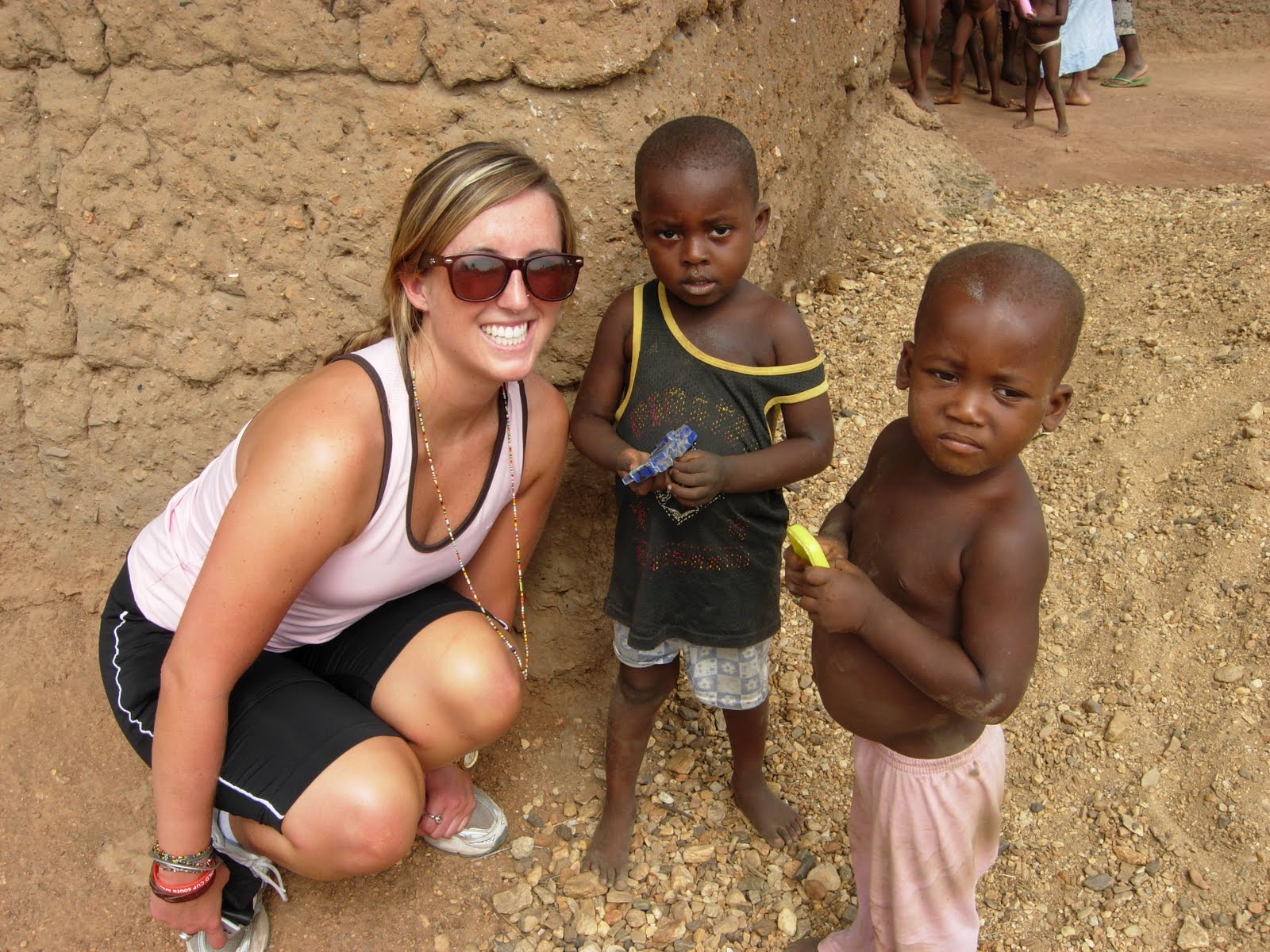
After playing with the monkeys, we took a walk though the village. We got to see some of the homes and meet some of the people who lived there. Of course I was off playing with kids while they talked about some of the specific details of the homes. Next, saw the elementary school and got to talk to some of the kids who went there. It was neat to see that many of the kids carried their books or buckets of water on their heads. Although they didn't balance them quite as well (most used their hands), it was neat to see this popular act starting at such a young age.
After visiting with the people in the village, we headed back to the ship. On our way back, our bus pulled over so we could walk across the Adome Bridge instead of just driving over it like we had on our way there. The Adome bridge crosses over the Volta River. We also stopped to see the Akosombo Dam, which is just south of the Adome bridge. Later that afternoon we arrived back to the ship where we spent our last night in Ghana.

Another port behind us, only one more to go… Off to Brazil!

Thursday, May 6, 2010

Afadjato Mountain


On our second day in Ghana I left for my Volta Eco-Adventure trip. The first destination of our trip was Afadjato Mountain, the highest point in Ghana. But what road trip in a foreign country would be complete without stopping to use the restroom? Of course I had to be the one to ask our bus driver to stop since our tour guide seemed to have no intention of doing so. (I swear he wasn’t going to let us pull over until someone actually had an accident.) From the time that we asked our bus driver to pull over to the time that he actually stopped seemed like forever, so I figured that the place we were stopping had to be decent. Unfortunately, I could not be more wrong.

We pulled up to a roofless building at the edge of the main road, which was really just a tiled area surrounded by low-standing walls with signs for men and women. Inside the divided area for women there was nothing that resembled a toilet or even a hole in the ground. Instead, there was a ledge that slanted down into an area along the perimeter of the room. This would maybe make sense if there was water flowing through the outer edge, but something about peeing onto a tile floor just didn’t seem right. Not to mention, that the men in the area next to us and I’d bet the people on the bus, could most likely see straight into our “bathroom.”
On that note, I walked out of the bathroom (if you even want to call it that), turned to my tour guide, and said, “Ya know I’d be pretty content with just peeing in those bushes over there if it’s okay with you.” It was at this point that I’m pretty sure I shattered any dreams he had of American women being perfectly ladylike because he was looking at me like he was a little appalled. So I took that as a “no” and decided I should just use the tile floor and embrace the experience with some of the other girls. I’m not sure if this is what all of the bathrooms are like in the rural areas, but if it is, I’d really encourage them to reconsider the good old outdoor thing, it makes much more sense.

I apologize if it seems like I go into major detail about something as little as an experience of using a public bathroom. However, it is these small experiences that really contribute to the trip in a big way. Not only does it completely desensitize you to any discussion of bathrooms or bodily functions, but it automatically creates a bonding experience among you and your travel mates. Trust me when I say that peeing on a tile floor is the least of what I’ve seen and experienced in my travels. And my shipmates would all agree with me when I say that there is no such thing as privacy or too much information anymore… we have all gotten a little too comfortable with each other. Anyway, moving on...

We finally arrived at Afadjato Mountain for our hike around late morning. We asked our tour guide how long it would take us to reach the top and he said that at the most it would take us 45 minutes. I didn’t think this was possible until I realized that we would be climbing vertically for almost the entire hike. I knew this because every time I stood straight up, I could feel the weight of my backpack pulling me backward. (I could picture the domino effect that this would ensue on the 20 people that were following directly behind me.) I would not have brought my backpack if it wasn’t for the fact that SAS terrifies us into keeping our stuff with us at all times and make it very clear that they are not responsible if we lose our stuff, including our passports, which would prohibit us from finishing the voyage. My logic was that if my parents found out I wasn’t able to finish the voyage and get credit for my courses, I might as well fall down the mountain, because I was going to be dead anyway.

Luckily, the trip up the mountain went pretty quickly since my tour guide didn’t believe in taking any breaks. I was beginning to see a trend… no bathroom breaks, no hiking breaks, etc… So I shouldn’t have been surprised when there seemed to be no plan in breaking for lunch. At this point I was wondering if I accidentally signed up for fat camp because it was beginning to feel like he was intentionally starving us. Until we drove to a village where we were given a little rabbit sized sandwich that we were supposed to eat on our walk to the waterfalls. Either he was pressed for time or this really was an attempt to make us lose weight. Thankfully I bought a bag of cookies from a lady in the village and gave my tour guide a look as if to say, “Yea that’s right, we American women also like to eat... Got a problem?”

Friday, April 30, 2010

Only in Ghana


 We arrived in Ghana on April 11th at our port in Tema.  Although Tema was where our ship was docked, the destination of our trip was Accra, a major city in Ghana that is located about 45 minutes away from Tema.  Luckily, we were provided with an hourly shuttle service to take us to and from Accra.  Although the drive wasn’t anything too scenic, it was still interesting to see the different Ghanaian people on the side of the road, particularly the ones who were carrying large baskets or buckets on their heads.  I didn’t think people still did this!  However, it is extremely common to see a woman carrying what looks like 10 pounds worth of vegetables or grain on her head.  (I still haven’t decided if it’s better or worse for your back and neck.  Either way, it’s quite impressive.)

When we arrived in Accra, we walked around a little bit.  I formulated a few initial impressions of Ghana.  My first was that it was more developed than I had imagined it to be, in that there were restaurants and shopping centers.  However, there weren’t really any skyscrapers and there were only a few tall buildings.  Accra also didn’t seem to be nearly as populated as any of the other cities we’ve visited.  I noticed it was dirty, but not as dirty as India.  The traffic wasn’t great, but the rules of the road seemed much clearer than they had been in China, Vietnam, and India.  The people were pretty homogeneous, which was a big change from Cape Town where there was so much diversity.  However, many of them spoke English and they were all very friendly.  The men in particular were very friendly… and very forward.  They were always trying to sell you something, whether it was a bracelet or the idea of marrying them, they were very persistent.  “No, you don’t want to be my wife?  I have an idea.  You spend a little time with me today and then if you see that you like me, then we get married.  Okay?  Good plan?  I think it’s a good plan.”  (Or maybe they weren’t being any more forward, maybe this was just the first time we could actually understand what they were saying to us.)

We spent the rest of our day at Labadi Beach, a public beach with casual outdoor restaurants, local vendors, and lots of entertainment.  There were crowds of people dancing, playing soccer, and swimming.   There were horse rides along the beach, acrobats, and other performers.  We found a table at a restaurant on the beach and decided to have lunch since we were starving.  We placed our order, sat back, and relaxed.  However, no more than 30 seconds after our waiter left the table, we were greeted by about 5 different locals trying to sell us their products.  They had paintings, bracelets, drums and, you guessed it, more marriage proposals.  We bought a few things but mostly told them that we were eating lunch and would rather they come back later.  For the ones that listened, this meant stand 5 feet away and wait for us to eat lunch.   However, most of the others completely ignored our requests and instead, circled our table until they found someone who was willing to listen to them (in other words, someone who looked like a push-over.)  They would then explain why we “had to buy” their wooden statue because their brother had spent “all day” making it and we “wouldn’t find it anywhere else” –a story that was hard to believe when, just on the other side of the beach, we could see a man making the same exact thing, each one taking no more than 5 minutes.

Our waiter came back with our drinks and told us that our food would be out shortly.  We sat and sipped on our drinks while we waited for our food.  It didn’t take long before the weak ones at the table started to cave.  I looked over and saw my friend being manipulated into buying some of the ugliest pieces of jewelry I’ve ever seen, while others were foolishly overpaying for t-shirts because the man had apparently gone all the way over to the other side of the beach to get them in their size. 

In order to get away from this madness, I walked away from the table to watch some of the performers.  Of course, the first bit of talent I see is a man breaking a glass bottle, eating the pieces of broken glass, and then throwing them back up.  I will forever be scarred from this image.  But before I could even get back to my table, the man who had swallowed & regurgitated the glass bottle was standing in front of me asking for money for watching his performance.  I should’ve known better.  Just when I thought it couldn’t get any crazier, I come back to the table and find Jane getting a manicure!  (What?!)  Not just any manicure, an awful one, and at the table we would soon be eating on. Only in Ghana…

It was no surprise that the next 3 times our waiter came back to the table it was only to refill our drinks and to tell us that our food would still be another few minutes.  It started to become very clear to us that this was all part of their plan: Take a bunch of young American tourists and give them a few drinks—on an empty stomach and in this heat—the random wooden statues start to look pretty appealing.  By the time we did get our our lunch and the bill came, we were lucky we still had money left to pay.  Looking back, if I had to sum up this afternoon in one word it would “circus” because it is the only word I can think of that even comes close to capturing the ridiculousness of this experience.


Monday, April 26, 2010

Day of Silence

In between Capetown and Ghana I participated in “Day of Silence.”  Yes, you heard me correctly—silence for a whole day, meaning no talking.  I did it to take a stand against the bullying and harassment of members of the LBGTQ (lesbians, bisexuals, gays, transgender, and questioning) community.  The day of silence symbolizes the way that LBGTQ members and their allies are silenced.  Earlier this semester I went through the safe zone training so that I could serve as an ally for LBGTQ.  I have a sign on my door to let people know that it is safe for them to come and talk to me.  The sign reads “This is a safe zone.  I am understanding, non-judgmental, and willing to provide an atmosphere of acceptance and assistance for members of the LBGT community.”  Participating in Day of Silence was another way for me to show that I am an ally. 

In my Human Sexuality class, one of the topics we study and discuss is sexual orientation.  We look at its role throughout history and around the world, particularly focusing on the countries we visit.  Doing this allows us to go into each country with an understanding of where it has been and where it presently stands on issues of homosexuality.  What I learned was shocking.  Had I not been taking this class and looking out for it in each country, it probably wouldn’t have crossed my mind.  However, putting myself in the shoes of someone who is LBGTQ, it is impossible to ignore the tremendous consequences that “coming out of the closet” can have on a person’s life.  For example, I learned from one of my gay friends that, in 80% of the countries in the world, it is illegal to be homosexual.  Two of them are countries we have visited—Ghana and Mauritius.  However, even in countries where homosexuality is legal, such as the United States, it is not always safe for a person to come out.

I attended a “coming out” panel earlier in the semester where people shared their experiences of opening up to their friends and family about their sexuality back in the U.S.  Many people said that they had the most difficulty coming out to their families, particularly their parents.  However, once they did, many of them found that their parents were completely accepting, even if it took some time for them to get used to it.  Unfortunately, not everyone’s story was this way.  A few people shared about the way that one or several of their family members have openly expressed disgust or disapproval of homosexuality.  These attitudes have forced them to stay in the closet for years.  This has inevitably created a distance between them and their families and has instilled in them a fear of going back home.  The alternative to this would be spending time at home and constantly living a lie.  Many of the people had experienced so much psychological pain that they admitted to having thoughts of suicide at one time or another. 

Hearing these stories of people coming out to their parents in the United States, I can only imagine a person trying to “come out” in another part of the world, such as South Africa where a woman can be correctively raped if she is suspected of being a lesbian or Brazil where a 19 year old man was attacked and murdered in 2007 for being homosexual.  I thought about what it would be like to travel to one of these countries, knowing that it wasn’t safe.  For this reason I have chosen to be an ally to others on this ship.  Participating in Day of Silence was a way to recognize those who don’t have a voice.

As for keeping the silence, it was extremely difficult.  Not only because I am a huge talker, but also because it fell on a day that I would normally teach yoga.  However, everyone seemed to enjoy the silent yoga class and it allowed me to communicate in other ways.  It was actually quite refreshing.


Sunday, April 25, 2010

Amy Biehl

While we were visiting the townships in South Africa, we drove along the street where Amy Biehl was murdered in 1993. Amy was an anti-apartheid activist. She was a white woman who graduated from Stanford University and studied at the University of the Western Cape in Cape Town. She was driving one of her black friends back to their home in Guguletu when she was stoned and stabbed to death by a group of black men. Amy was only 26 years old at the time, not much older than I am now. It was impossible not to picture the very scene happening right in front of me—how afraid she must have been, and yet, how brave she had to be for even putting herself in such a situation (being a white woman in South Africa & doing the work that she did) while knowing the risks that were involved.

Hearing about Amy’s death from our cab driver was sad and moving. However, her story was particularly meaningful to us because just a few days earlier Linda Biehl, Amy’s mother, had come onto our ship and shared Amy’s story with us from her perspective. When Linda spoke about the day she found out her daughter died, I could feel my heart break—not because she cried or sounded depressed—but because I could only picture my own parents at home and how they would feel if they had to receive that phone call that Amy’s parents did on that day in 1993. But Linda made it clear that the point of her story was not Amy’s death but about what Amy’s life stood for and what happened after her death.

During her time in South Africa, Amy had expressed to her parents the situation that was going on regarding racial violence and explained the anger of the black people, particularly after one of their young leaders had just been assassinated. (I am writing this mostly from memory so I don’t know the name of the person but I believe he was thought to have the potential to be the next Nelson Mandela.) So when Amy died a short time after this, her parents knew that this issue was much bigger than Amy and they understood that it was not personal. If they chose to hate the people who killed her, they would only be contributing to the hatred that Amy spent her life trying to end. Instead, Amy’s family decided to set up a foundation in her honor that helps disadvantaged communities, particularly members of the youth, in the townships of Cape Town. Not only do they work to help the community where their daughter was killed but they have also made peace with her murderers and two of them currently work for the foundation.

I chose to share this story in my blog because it touched my heart and has continued to inspire me throughout my journey around the world. I believe that Amy’s story is the perfect example of the way that one person’s life can impact the world. However, I also believe that it holds a message that is quite the opposite. And that is that there is a love that is so much bigger than any of us human beings—a love that has the power to forgive even the most hurtful of acts, a love that transcends time and doesn’t know race… a love that is so much bigger than this planet. As I travel around the world, I get to know this love a little bit better every day. Every person I meet and story I hear brings me back to my heart and closer to this great love.

Tuesday, April 20, 2010